
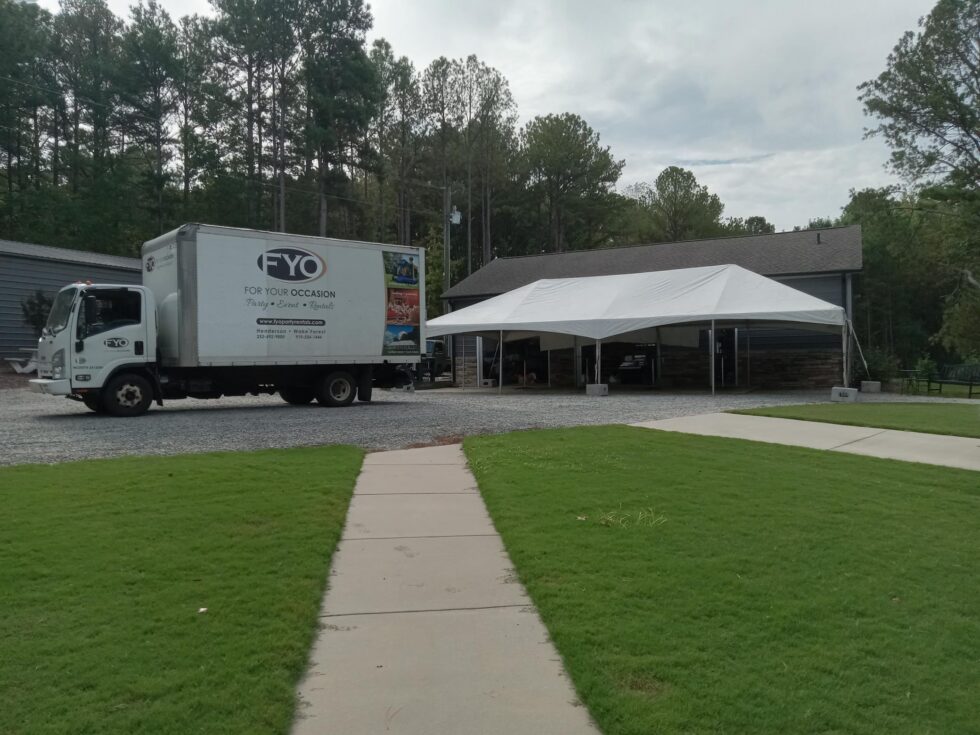
When planning an event, it can be easy to think of delivery as simply loading rental items onto a truck and dropping them off. In reality, a successful event rental delivery requires detailed planning, trained employees, specialized vehicles, warehouse preparation, safe installation practices, and careful coordination.
At For Your Occasion Event Rentals, our logistics process begins well before our trucks arrive at your venue. Each delivery and pickup is planned to help protect your rental equipment, keep our crews safe, and provide dependable service to every client on the route.
Why Are Delivery and Labor Charges Necessary?
Delivery and labor charges cover much more than the fuel required to drive to an event.
These charges help support the cost of:
- Trained employees
- Employee benefits
- Payroll taxes
- Business and vehicle insurance
- Fleet maintenance and repairs
- Diesel fuel and gasoline
- Warehouse preparation
- Loading and unloading
- Travel time
- Equipment installation and breakdown
- Cleaning, inspection, and restocking
Rental equipment may be handled several times before and after an event. Items must be pulled from inventory, inspected, staged, loaded, transported, unloaded, picked up, returned to the warehouse, cleaned, inspected again, and placed back into inventory.
Delivery and labor charges allow us to provide the staffing, vehicles, insurance coverage, equipment, and operational support necessary to complete this process safely and professionally.
Planning Begins Before Delivery Day
Depending on the season, our routing process may begin one to two weeks before an event.
May, June, September, and October are typically our busiest months. During a busy week, FYO may complete approximately 25 to 30 deliveries and pickups, with as many as 10 to 12 stops scheduled in one day.
To create each route, our team considers:
- The address of each event
- Travel time between stops
- Delivery and pickup requirements
- The size and type of each order
- The number of employees needed for each route
- Installation requirements
- The capacity of each truck
- How many orders can safely fit on each vehicle
- Venue access requirements
- Traffic, weather, and road conditions
- The estimated time needed at each location
Routes are created using a combination of geography, event timing, truck capacity, staffing, equipment type, and installation requirements.
Our normal service area is generally within approximately 60 miles of our warehouse, although we have traveled farther for certain events.
Warehouse Preparation and Truck Loading
Before an order can be delivered, our warehouse team must pull, verify, and stage the equipment.
Whenever possible, orders are pulled and staged two to three days in advance. This allows our warehouse team to confirm that the correct items and quantities are ready and helps our delivery crews load trucks efficiently the day before delivery.
Truck loading requires careful planning. Our team must consider:
- The size and weight of the equipment
- The order in which deliveries will occur
- Which items must be unloaded first
- How the equipment should be secured
- How to prevent damage during transportation
- Whether all assigned orders will safely fit on the truck
The truck assigned to an order is based on the amount and type of equipment being delivered, as well as the number of other deliveries assigned to that route.
What Is Included in Standard Delivery and Pickup?
Our standard delivery service is a tailgate delivery.
This means our team will unload rental items at an accessible location within approximately 20 feet of where the truck can safely park. Depending on the property, this may include:
- A porch
- A driveway
- The side of a house
- An accessible area beside a venue
- A designated loading or delivery area
Standard pickup is handled from the same accessible location. Before pickup, rental items should be broken down when applicable, gathered together, and ready for our crew to load.
Standard delivery does not automatically include carrying items long distances, moving equipment through a building, using stairs or elevators, or setting up and breaking down tables and chairs.
Those services require additional time and labor and may result in additional charges.
Delivery Windows and Timing
FYO normally provides a four-hour delivery window approximately one week before the scheduled delivery.
Our earliest deliveries may begin around 7:00 a.m.
Delivery windows are determined by several factors, including:
- Truck assignments
- The number and size of orders on each truck
- Crew assignments
- Delivery addresses
- Travel time
- Installation requirements
- Venue restrictions
- The most efficient routing sequence
Although our team estimates how long each delivery or installation should take, unexpected circumstances can affect the schedule.
These circumstances may include:
- Traffic delays
- Severe weather
- A flat tire or vehicle issue
- Limited venue access
- Delays at a loading dock
- A previous client adding items at the last minute
- A site not being ready
- A longer-than-expected carry or installation
- A client or venue representative not being present when required
For these reasons, we provide delivery windows rather than guaranteeing an exact arrival time for every order.
Our team will call before arriving.
Can I Request a Specific Delivery Time?
Clients may request a specific or restricted delivery time. However, an exact-time delivery may require an additional charge.
A specific time request can affect the entire route. It may require us to:
- Reorganize other deliveries
- Assign a separate truck or crew
- Send a truck outside its normal geographic route
- Begin earlier or work later
- Limit the number of deliveries assigned to that vehicle
- Schedule additional labor or overtime
Whether an additional charge applies will depend on the requested day, time, location, equipment, crew requirements, and impact on the remaining delivery schedule.
Specific delivery requests should be communicated as early as possible. A requested time is not considered guaranteed unless it has been reviewed and confirmed by FYO.
Pickup Timing
Standard pickups are generally scheduled for the following Monday or Tuesday, depending on the event date, location, truck capacity, and routing schedule.
Immediate pickup after an event is not automatically included with standard service.
In some cases, FYO may be able to provide:
- Same-night pickup
- Immediate post-event pickup
- Sunday pickup
- Holiday pickup
- After-hours pickup
- A specific pickup time
These services depend on crew and truck availability and may require an additional fee.
A guaranteed pickup time can require a dedicated crew, a separate route, after-hours labor, or overtime. Clients who need equipment removed immediately due to venue restrictions should provide that information before finalizing the order.
Why Can Last-Minute Changes Affect Routing and Pricing?
We understand that event plans sometimes change. However, adding equipment shortly before delivery can affect more than the rental order itself.
When larger items or additional quantities are added, our team must determine:
- Whether the new items will fit on the assigned truck
- Whether a larger truck is needed
- Whether the route must be reorganized
- Whether additional employees are required
- Whether the added work will delay other deliveries
- Whether the crew may incur overtime
- Whether the warehouse team has time to pull and stage the items
- Whether the added equipment is available and ready to rent
Even a small order change can affect truck capacity, warehouse preparation, labor, and delivery sequencing.
Last-minute additions may result in additional delivery, labor, handling, or overtime charges. They may also affect the original delivery window.
Finalizing quantities and equipment selections early helps us plan more efficiently and reduces scheduling complications.
Why Setup and Breakdown Require Trained Labor
Many rental items are not simple consumer products. Tents, stages, dance floors, and related equipment are temporary structures that must be installed according to specific procedures.
Our teams follow established installation guidelines for safety and insurance purposes.
Professional installation may involve:
- Evaluating the installation area
- Identifying slopes, soft ground, or unsafe conditions
- Measuring and laying out the installation
- Confirming equipment placement
- Securing structural components
- Installing stakes, weights, flooring, or supports
- Inspecting the completed installation
- Safely dismantling and loading the equipment after the event
Improper installation can damage the rental equipment, damage the property, or create a serious safety hazard. Certain equipment must therefore be installed and removed by trained FYO employees.
What Services Require Additional Labor Charges?
Services that may require additional labor charges include:
- Carrying equipment more than approximately 20 feet from the truck
- Table and chair setup
- Table and chair breakdown
- Carrying items up or down stairs
- Using elevators
- Moving equipment through long hallways
- Navigating narrow gates or entrances
- Indoor deliveries or installations
- Waiting for the client or venue representative
- Waiting for venue access
- Working within restricted setup or pickup periods
- Relocating items after delivery or installation
- Handling equipment in wet, muddy, steep, or unsafe conditions
- Providing an exact-time delivery or pickup
- Providing after-hours, Sunday, holiday, or immediate pickup service
The need for added labor is determined by the time, access, staffing, equipment, and site conditions associated with the order.
Site and Venue Conditions That Can Increase Costs
Every property and venue is different. Access conditions can significantly affect the amount of labor and time required.
Conditions that may increase delivery or labor charges include:
- Stairs
- Elevators
- Long carrying distances
- Parking restrictions
- Limited loading dock access
- Soft or uneven ground
- Hills or slopes
- Wet or muddy ground
- Narrow gates
- Narrow doorways
- Indoor installations
- Restricted setup times
- Restricted pickup times
- Waiting for access
- Waiting for the client
- Equipment being moved after placement
- Unsafe working conditions
- A lack of nearby truck access
For example, unloading chairs beside an outdoor event space is very different from carrying those same chairs through a parking deck, into an elevator, down a hallway, and into a ballroom.
The equipment quantity may be the same, but the time and labor required are not.
Accurate site information allows us to prepare an appropriate quote, assign the correct number of employees, and schedule enough time to complete the work safely.
What Clients Should Provide Before Delivery
Clients can help the delivery and installation process go smoothly by providing complete information in advance.
Before delivery, please provide:
- The complete and accurate delivery address
- The correct venue name
- A reliable onsite contact and telephone number
- A site map or setup diagram
- The requested location of the tent
- The placement of tables, chairs, stages, dance floors, or other equipment
- Loading dock and truck access instructions
- Information about stairs, elevators, hills, gates, or long carrying distances
- Venue access hours
- Restricted delivery or pickup times
- Parking restrictions
- Certificate of insurance requirements
- Information about underground utilities
- Any site or venue rules that could affect the delivery
Tent locations should be clearly identified before our crew arrives. Clients may use stakes, flags, cones, spray chalk, or another approved method to show the intended placement.
The installation location should match the diagram and instructions previously provided to FYO.
Preparing the Site for the Crew
Before our team arrives, please make sure:
- The delivery and installation area is cleared
- Vehicles are removed from the setup area
- Gates and doors are unlocked
- Pets are secured
- The truck has a safe and accessible parking or unloading area
- Venue access has been confirmed
- The tent location has been clearly marked
- Final equipment placement has been decided
- An authorized person is available when needed
- Rental items from a previous event are not blocking the area
Clients who request to be present should be onsite and available during the entire delivery window.
If our crew arrives and the client is not present, the site is not ready, the installation location has not been marked, or the venue cannot be accessed, the crew may need to continue to the next scheduled delivery.
A return trip, extended waiting time, or route delay may result in an additional charge.
A Successful Event Is a Team Effort
Behind every delivery is a team of warehouse employees, drivers, installers, route planners, and support staff working together to prepare your order and deliver it safely.
Our goal is to make the process feel easy for the client, even though several days of preparation and coordination may be happening behind the scenes.
By finalizing your order early, providing accurate site information, communicating venue restrictions, marking the installation area, and preparing the site before our arrival, you help our team stay on schedule and provide dependable service to every client.
At For Your Occasion Event Rentals, we are proud to handle the logistics so you can focus on your event.